
power. water. remediation.
Multiple Functions. One Integrated Solution.

1 • We All Agree …
The demand for power, pure water, adequate sanitation, and reduced pollution is rising while traditional infrastructure grows more expensive to replace, upgrade, or expand.
Electrical generation, water purification, desalination, sewage treatment, and industrial waste remediation traditionally require separate infrastructure systems, often distributed across multiple facilities.
This often increases capital expenditures, land usage requirements, operational complexity, environmental burden, and long-term cost exposure.
Communities, industries, utilities, and governments are increasingly faced with difficult infrastructure decisions that influence economic growth, quality of life, and environmental stewardship for decades.
What is needed is an integrated infrastructure solution with funding resources to help move promising projects from concept to reality – modular, scalable systems designed for long-term operation.

2 • SOLUTIONS PROVIDED
Multiple challenges can now be simultaneously addressed through emerging infrastructure technologies that combine functions traditionally requiring separate facilities and operating systems.
GEN365, working with governments, utilities, developers, and industrial organizations, helps evaluate and structure projects where this technology provides practical advantage.
Our focus is helping organizations develop scalable and economically sustainable infrastructure that addresses both current and long-term requirements.
This website is intended to provide general infrastructure context and does not disclose proprietary technical information or identify specific technology providers.
Detailed technical solutions and introductions to infrastructure, technology, funding, and deployment partners occur only after appropriate confidentiality and formal engagement agreements have been established.
GEN365 is an independent advisory and integration group partnering to help organizations evaluate, structure, fund, and deploy infrastructure projects. We do not manufacture equipment, sell technology, or operate as a reseller.

3 • cOST INVERSION
Using technology to transform operational burdens into productive resources is a process we call cost inversion.
Each infrastructure process carries its own costs for:
• energy and fuel expense
• land and facilities
• waste disposal
• management and personnel
• other related operating expenses
When systems are integrated, certain waste streams and operational inputs can contribute to productive functions within the overall process. Materials previously regarded only as disposal or remediation costs may instead provide beneficial value, including impaired water and municipal or industrial waste streams.
As a result, the financial model changes. Costs that were once treated solely as ongoing expenses may partially offset operational requirements while contributing to useful outputs.
Potential benefits include:
• lower operational complexity
• improved land efficiency
• lower fuel dependency
• increased infrastructure resilience
• more favorable long-term economics
This evolving infrastructure model is one reason integrated systems are receiving growing attention from municipalities, utilities, industrial operators, and large-scale development projects.

4 • clear path forward
Scalable integrated infrastructure can transform operational burdens into productive resources and turn costs into beneficial assets for any size project.
GEN365.energy helps align technologies, partners, funding, and project execution to support responsible deployment, long-term performance, and successful infrastructure outcomes.
Depending on project requirements and the disciplines already available within the client's organization, GEN365 may:
Define infrastructure objectives, evaluate solution pathways, and assess technical and operational suitability.
Develop scalable deployment strategies and coordinate with qualified engineering and infrastructure partners.
Structure projects, partnerships, and funding relationships to support long-term viability.
Assist with project implementation, operational continuity, and performance oversight.
Participate in long-term project management and stakeholder coordination.
Each project is deployed through a dedicated entity formed specifically for the defined infrastructure objective. This approach provides clear alignment among stakeholders, operational responsibilities, funding participation, and long-term performance objectives.
Rather than maintaining a fixed engineering, construction, or funding structure, GEN365 assembles project-specific teams and partners based on the unique requirements of each project.
We are an independent advisory and integration group. We do not manufacture equipment, sell technology, or operate as a reseller.
Our goal is not simply to introduce technologies, but to help ensure that projects are structured responsibly, executed effectively, and managed successfully over time.

5 • current interest
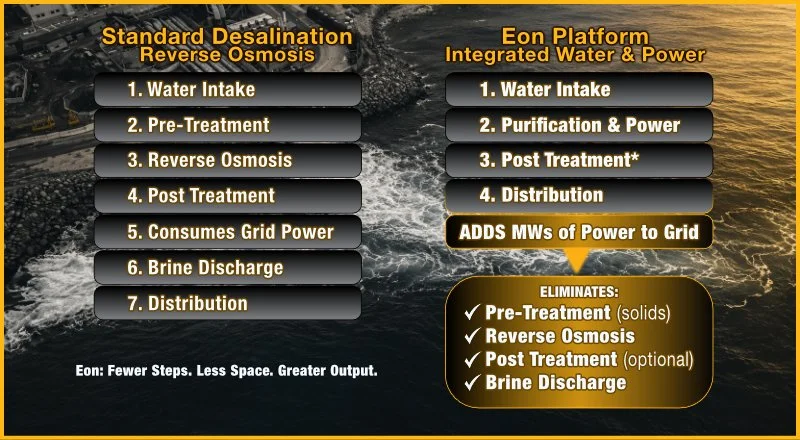
GEN365 evaluates multiple infrastructure approaches. One area currently receiving significant attention involves what we refer to as Eon-class platforms that have the potential to redefine how critical infrastructure is deployed and operated.
These highly integrated systems can combine functions that have traditionally required separate facilities, fuel sources, and operational teams. Depending upon project requirements, an Eon-class deployment may integrate power generation, water purification, desalination, and waste remediation within a single modular infrastructure.
The potential economic and operational implications of this approach have generated considerable interest among municipalities, industrial operators, developers, and infrastructure investors.
The illustration provides a simplified example of how integrated systems can reduce operational complexity and improve overall project economics.
Click these to learn more:
• Infrastructure Summary • Technical Paper_FAQs •

6 • Tech Integration
Modern infrastructure platforms can now integrate power, water, and remediation functions across projects ranging from local facilities to utility-scale deployments.
Selected technologies are capable of integrating:
electrical power generation
water purification/desalination
wastewater remediation
waste-to-energy processes
Depending upon project requirements, some systems may support:
utility-scale or distributed deployment
grid-connected or islanded operation
modular scalability from localized systems to gigawatt-scale projects
co-located water production and waste remediation
synthetic fuel generation from water-based process streams
Systems for client evaluation are capable of processing and utilizing:
municipal water
groundwater
surface water
seawater
impaired or contaminated water
industrial wastewater
agricultural runoff
Several of these capabilities have broader technical and economic implications than may be apparent at first review and are discussed in greater detail during follow-up communications.

7 • project execution
A disciplined process transforms objectives into actionable plans, executable agreements, and long-term operational success. Upon agreeing to formally proceed with a project, the following steps serve as key milestones:
1. Engagement Structure
Finalize formal agreements and partnership structure
Determine participation structure, project roles, and commercial alignment
Review budget parameters and funding considerations
2. Project Definition
Define project objectives and infrastructure needs
Identify site, utility, operational requirements, and resources
Establish scale, timing, and deployment goals
Review current planning status and project readiness
3. Project Structuring
Confirm suitable infrastructure approaches
Coordinate technical alignment and deployment planning
Formalize project framework and implementation approach
4. Contract & Launch
Finalize project agreements
Coordinate funding, deployment, and operational launch
Transition into long-term project execution and management
A clear, disciplined path from concept to operating infrastructure.

8 • value of GEN365
Organizations engage with GEN365 to evaluate how integrated infrastructure solutions can improve project economics, resilience, scalability, and long-term performance.
Traditional infrastructure often evolves through incremental repair, replacement, and expansion. Emerging technologies are now creating opportunities to rethink that approach by integrating functions that have historically required separate systems, facilities, and operating structures.
For some organizations, the question is no longer whether existing infrastructure can be maintained, but whether newer approaches may offer a more practical, efficient, and sustainable path forward.
If your organization is evaluating opportunities involving power generation, water purification, desalination, or waste remediation, we welcome the opportunity to discuss your objectives and determine how GEN365 may assist you in reaching your goals.

9 • Contact Us - It Begins Here
We invite you to send us an email or use the contact form below to arrange an initial discussion and to receive additional information.
Send an email to: project@gen365.energy